
Kestrel
2026 · AI Product Builder
AI career intelligence system that turns job descriptions into structured role signals, transparent comparisons, and next-step action plans.
Tested action-plan outputs with 15 users to refine UX, app language, and structure, improving clarity of AI-generated outputs.
Kestrel is an AI career intelligence system for candidates comparing their background against a specific job. It uses LLM prompts and JSON schemas to translate job descriptions into structured requirements, then presents the comparison in an explainable dashboard with clear next-step guidance.
Key Product Decision
Kestrel could have been a chatbot, but chat would have made the hardest part easier to avoid: ranking the user’s next move. I chose a structured card-based dashboard so the system had to show what it found, why it mattered, and what the user should do first. That constraint made the product more useful for career prep and more credible as a decision-support tool.
Product Thesis
Career preparation is not an information shortage problem. Candidates already have job posts, advice, and resume feedback. What they lack is a ranked order of operations tied to the specific role they want.
Product Bet
A structured output that ranks requirements, gaps, and next steps is more useful than a chat interface that gives advice without prioritization.
Candidates preparing for a target role often work from scattered inputs: job posts, resume edits, advice threads, and unclear role expectations. The result is effort without sequence. They keep revising materials before knowing which gaps matter most, and they lack a clear way to judge whether they are ready for a specific role.
Job descriptions mix hard requirements, soft preferences, and filler language, making it hard to tell which gaps are serious and which are negotiable.
Candidates often revise their resume before knowing which capability gaps actually matter for the role.
Generic AI tools can produce advice, but they rarely rank what matters first. They list options without turning them into a decision path.
Built for candidates who need to compare their background against a target job and decide where to focus preparation time.
Primary User
Candidates applying to target roles who need a faster way to assess fit and prioritize preparation for each specific job.
Job To Be Done
Show me where I stand against this role, rank what I should work on first, and give me a next step I can use before applying.
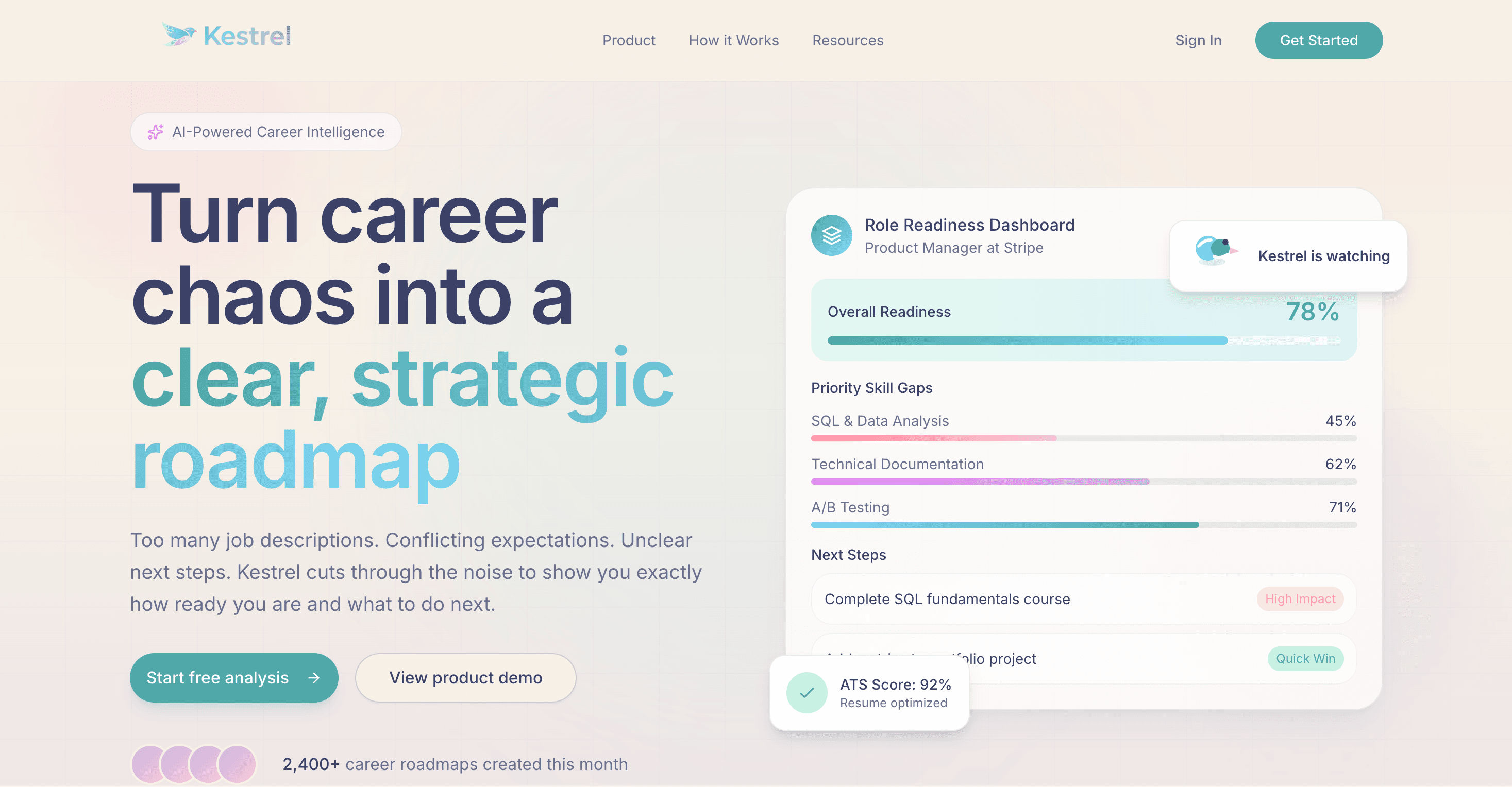
Kestrel parses the job description into structured role signals, compares those signals against the user profile, and returns matched strengths, prioritized gaps, and next-step guidance in a comparative dashboard designed for fast scanning and clear interpretation.
Requirements Extraction
Parses job descriptions into structured role signals, separating hard requirements from soft preferences so candidates see what the role actually demands versus what it merely mentions.
Ranked Gap Analysis
Compares extracted requirements against the user profile and returns a ranked view: what is strong, what is marginal, and what is missing, ordered by likely impact on the application outcome.
Roadmap Generation
Converts the gap analysis into a concrete, sequenced action plan so users leave with a specific order of operations, not a general list of things to improve.
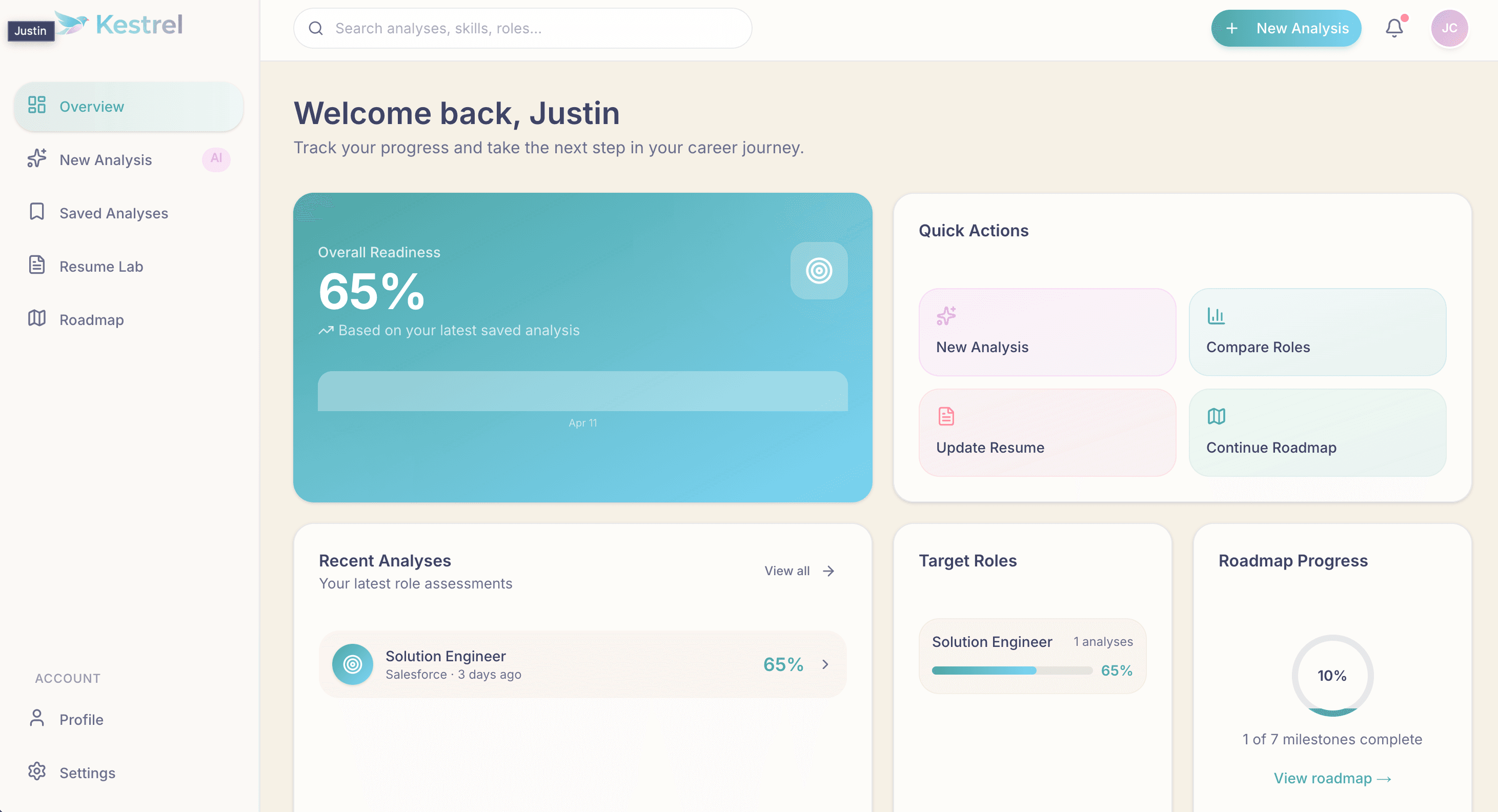
Kestrel decision dashboard
Tested action-plan outputs with 15 users to refine UX, app language, and structure, improving clarity of AI-generated outputs.
Testing with 15 users refined the UX, app language, and structure so the dashboard made AI-generated outputs clearer and more actionable. The result is a product that turns scattered career prep into a more focused decision workflow.
User Testing Signal
Testing with 15 users sharpened the product language and structure so candidates could interpret outputs faster and with less ambiguity.
Product Signal
The value is not more advice. The value is turning a target role into structured requirements, transparent comparisons, and a clear next step.
The hardest technical problem was normalizing inconsistent job description text into structured, comparable role requirements. A staged AI pipeline with typed output schemas kept requirements, comparisons, and next-step outputs consistent enough to render reliably and stay explainable to the user.
Structured Extraction
Typed output schemas constrained the AI pipeline to return requirements in a consistent shape, which is critical for rendering, ranking, and comparing results across different job descriptions.
Explainability by Design
Card-based outputs were a deliberate constraint: each recommendation had to be specific enough to attribute to a requirement and readable in under ten seconds without additional context.
The strongest product decision was restraint. An early version expanded into broader coaching and resume rewriting. The product became stronger once it stayed focused on structured comparison, explainable gaps, and next-step guidance.
What I Cut
Resume generation, open-ended coaching, and broad career comparison. All of it expanded the surface area without improving the core decision a user needed to make.
What Remained
Role signals, gap analysis, and next-step guidance appear in ranked order, specific to the role. Once the scope narrowed to those outputs, the product felt like a tool rather than a demo.